
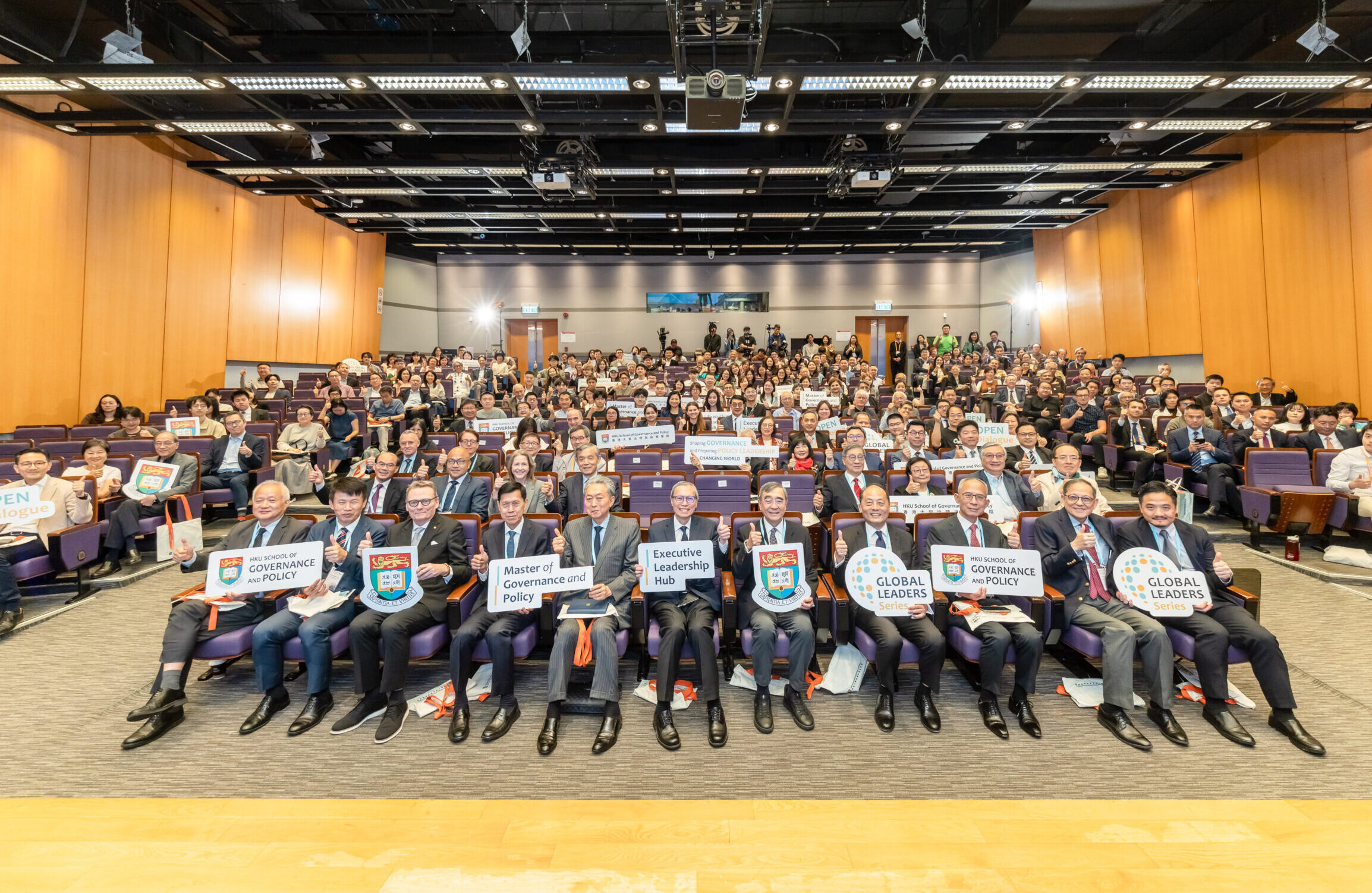
HKU School of Governance and Policy is delighted to invite you to the Global Leaders Series, a distinguished two-day event taking place from November 3 to 4, 2026. It brings together prominent voices to explore critical global topics, including economic relations, social and demographic challenges.
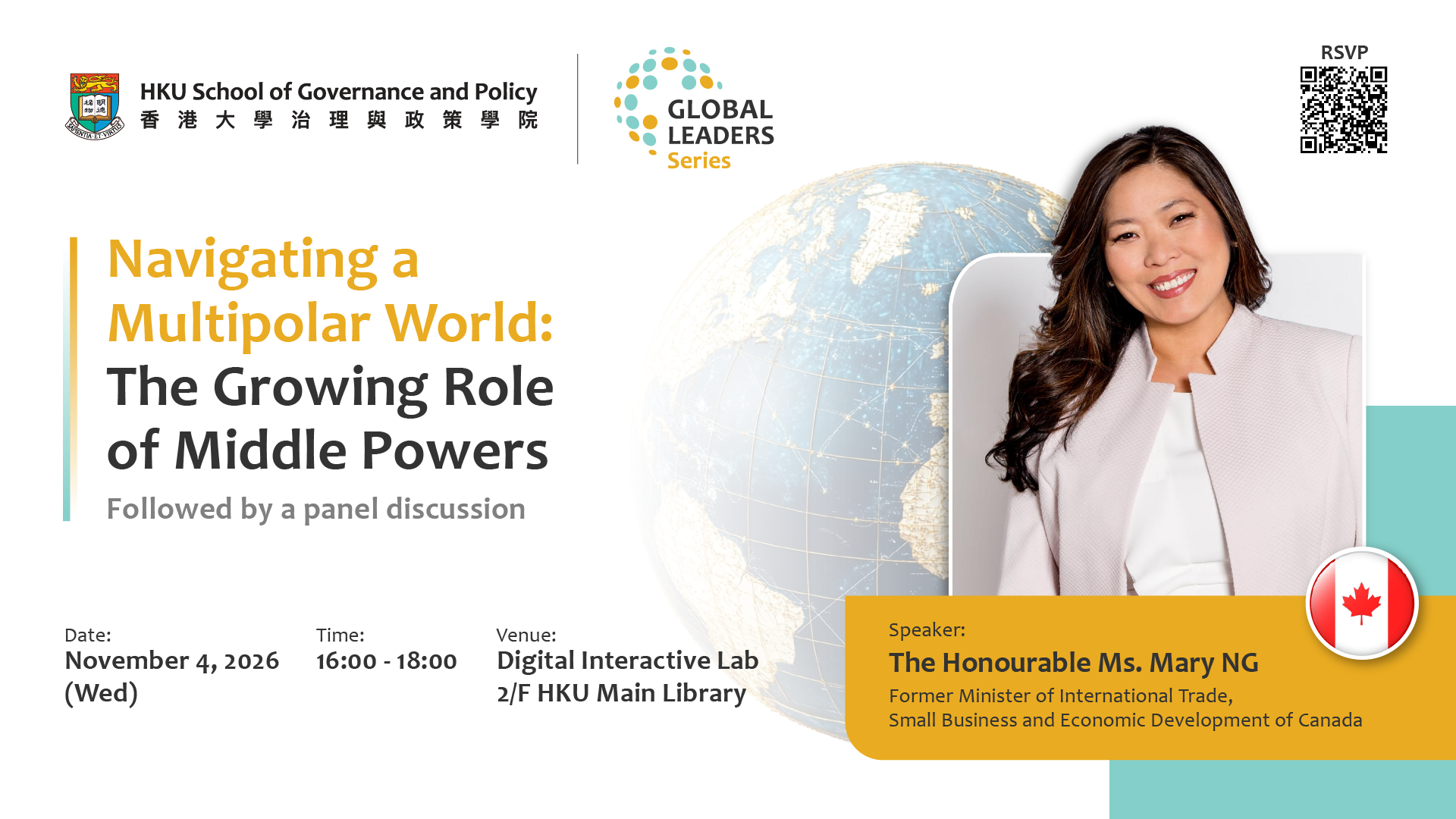
On November 4, the Series will feature The Honourable Ms. Mary NG (Former Minister of International Trade, Small Business and Economic Development of Canada), to deliver a thought-provoking lecture followed by a panel discussion and an interactive Q&A session, providing participants with valuable insights and opportunities to engage with expert perspectives.
November 4, 2026 (Wednesday) | Navigating a Multipolar World: The Growing Role of Middle Powers
Time: 16:00 – 18:00
Venue: Digital Interactive Lab, 2/F Main Library, HKU
Speaker: The Honourable Ms. Mary NG (Former Minister of International Trade, Small Business and Economic Development of Canada)
Registration: Click Here (Deadline: November 2, 2026)
Enquiries: gleaders@hku.hk
Speaker
The Honourable Ms. Mary NG
Former Minister of International Trade, Small Business and Economic Development of Canada
Lecture
Navigating a Multipolar World: The Growing Role of Middle Powers
Biography
The Honourable Mary Ng, P.C., is a globally respected voice on international trade, inclusive economic growth, and business leadership. From 2018 to 2025, she served as Canada’s Minister of International Trade, Small Business and Economic Development—becoming the country’s longest-serving Trade Minister.
A global leader in international trade, Mary led Canada’s trade agenda at the highest levels. She advanced key relationships with the United States and Mexico under CUSMA/USMCA and with the European Union through CETA, while deepening partnerships across Africa, CARICOM, and South America. As a principal architect of Canada’s Indo-Pacific Strategy, she strengthened trade and investment ties across the Asia-Pacific and expanded Canada’s engagement with ASEAN and India, consistently advancing Canada as a trusted, reliable rules-based trading partner.
During her tenure, Mary oversaw negotiations of major trade agreements, including the Canada–UK Trade Continuity Agreement (post-Brexit), the Canada–Indonesia Comprehensive Economic Partnership Agreement, a modernized Canada–Ukraine Free Trade Agreement, and the Canada–Ecuador Free Trade Agreement. She led Canada’s strategic engagement on Canada-ASEAN FTA negotiations, while guiding the United Kingdom’s accession to the Comprehensive and Progressive Agreement for Trans-Pacific Partnership (CPTPP), where she chaired the CPTPP Commission in 2024.
Mary represented Canada at the G7, G20, WTO, APEC, OECD and other multi-lateral forums – making her a truly global leader.
At home, she turned trade agreements into real opportunities for Canadian businesses, leading high-level trade missions that helped entrepreneurs expand internationally. Her leadership laid the foundation for a more inclusive, digital, and globally competitive business ecosystem, including championing the first-ever Women Entrepreneurship Strategy.
Since retiring from politics in 2025, Mary serves as a strategic advisor to Canadian and international businesses and speaks globally on trade, economic leadership, geopolitical risk and inclusive growth. She is also a Senior Fellow at the Milken Institute.
Abstract
The global order is being reshaped by geopolitical rivalry, economic uncertainty, technological competition and growing pressure on the institutions and rules that have governed international cooperation for decades. For middle powers, this is not simply a changing global order to navigate or adapt to, but a moment to play a more active role. Informed by her experience as Canada’s longest-serving Minister of International Trade, the lecture will explore how countries can build resilience through diversification, strengthen partnerships and deepen engagement across regions. It will examine how trade, investment and economic diplomacy can create practical coalitions among countries with shared interests, even when they do not agree on everything. It will also consider the importance of international institutions and predictable rules in a more fragmented world, and how middle powers can work across differences and use their economic relationships and institutions to act together. In doing so, they have the capacity to influence the direction of a changing global order and shape the rules that come next.
Stay connected with us for the latest updates:
Facebook | Instagram | Linkedin | YouTube | WeChat